
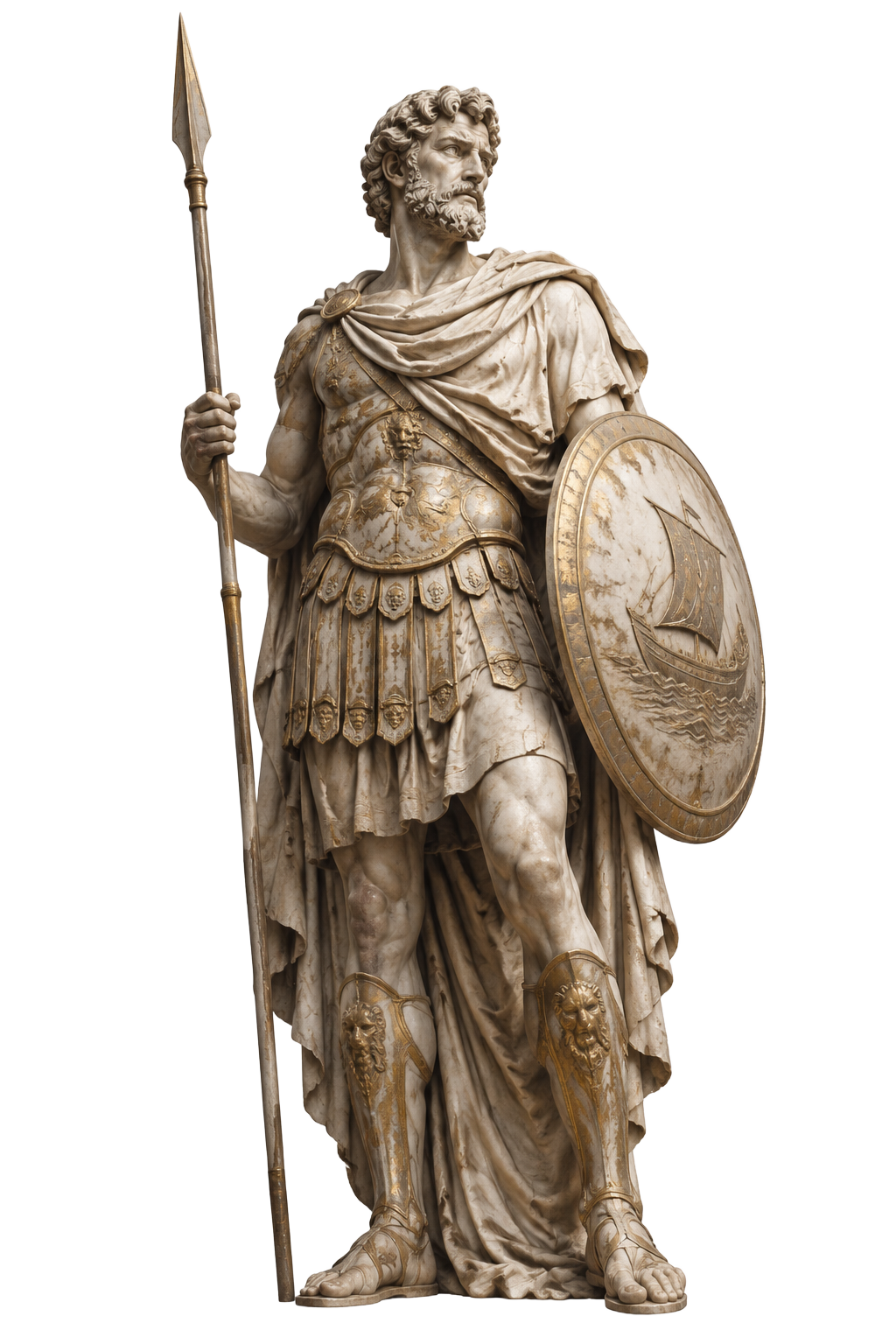
Prologue
The Story of the Name
Before you read anything else, understand why this company is called Odyssey.
Systems of Record are, by a wide margin, the hardest software ever built. They are the end-to-end operating system for an entire industry. Every workflow. Every edge case. Every regulatory quirk. Every angry customer at 11pm on a Sunday. To build one at scale — to become the source of truth that an industry cannot function without — takes ten years minimum. Fifteen is more common. Twenty is not unusual.
The founders who pull it off are, in the truest sense, warriors. They spent a decade grinding through problems the rest of the software industry never bothered to look at. They out-lasted the doubters, the copycats, the burnouts, the recessions, and the platforms that were supposed to eat them. They emerged with the memory of an entire industry sitting inside their database.
That is the Battle of Troy. And when a founder like that decides to sell their company to us, they have won it.
But Homer did not end the story at Troy. The victory was not the point. What came after the victory was the point.
The Odyssey is the ten-year voyage home. It is the sea monsters and the sirens and the storms. It is the transformation of the warrior from the person who won the war into the person who was worthy of coming home a legend.
You won Troy. Now come on the Odyssey with us.
That is what we are asking every founder who sells to Odyssey to sign up for. Take the System of Record you spent a decade building, and let's turn it into the vertical AI operating system for the next decade. We ship the Industry GPT. We flip the payments. We migrate the base. Compound the moat. Turn a $5M ARR company in a niche industry into a $50M ARR company that owns the industry's technology layer. Turn a great business into a defining one.
It will not be easy. Nothing worthwhile is. But it will be epic.
That is why the company is called Odyssey. It is a promise to every founder who joins us, and a warning to every operator who does. The battle is not over when you sell. The battle is just beginning. The good news is you no longer have to fight it alone.
✦
Part I
Where the World Is Going
Software is being redrawn in real time. The stack you learned about in business school or at a prior SaaS company is gone. What replaces it is a small, ruthless map of seven kingdoms — and knowing which one you're standing on determines whether you have a business in 2030 or a graveyard.
I laid the full map out here. Read it. But here is the compressed version:
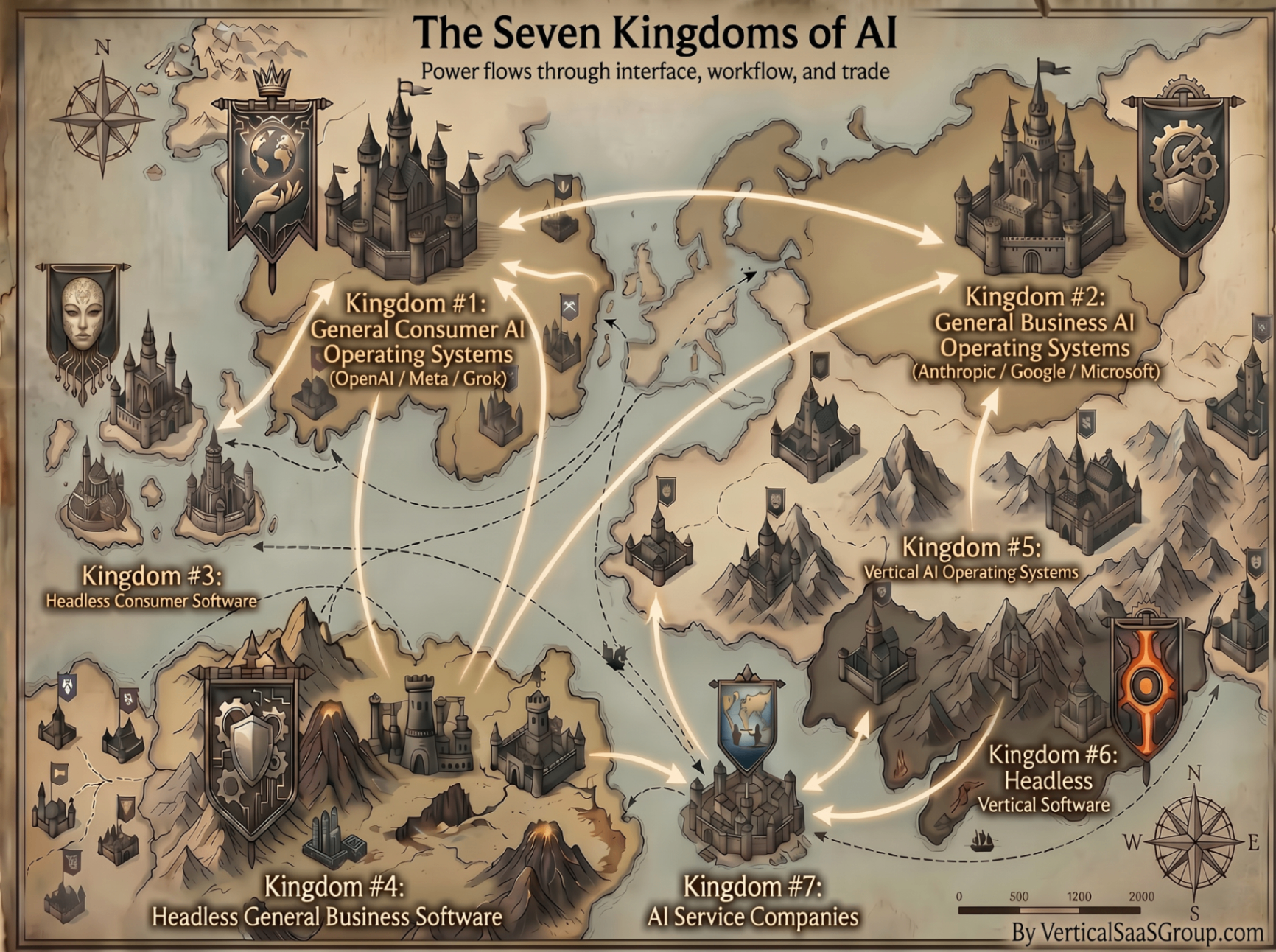
Enter a kingdom
Select a realm to see its place in the new software world.
Vertical AI Operating Systems
Health · Law · Build · CoinVertical AI Operating Systems. Health, Law, Build, Coin — and 500 industries the labs will never notice. This is where Odyssey lives.
This is the kingdom I'm most excited about, and the one I'm spending most of my time on. On the surface, a Vertical AI OS will often look a lot like Claude or ChatGPT: conversational, intelligent, and capable. Underneath the hood, it is a totally different product. It is trained on industry data, fine-tuned for industry workflows, wrapped in compliance and human services, and built to compress complex industry work into a few clicks.
The horizontal players have an endless roadmap just chasing the most valuable general-purpose tools. They aren't going all the way down into healthcare, legal, construction, insurance, financial operations, logistics, and hundreds of other markets with the depth those industries require. That leaves room for vertical winners built on industry context, regulatory depth, services, distribution, and trust.
Unlike horizontal AI, vertical AI isn't winner-take-all. Some markets produce one monopoly. Some produce two or three durable winners. Others support four or five strong players for decades. That structure creates room for a huge number of $10M–$1B companies, not just a handful of trillion-dollar outcomes.
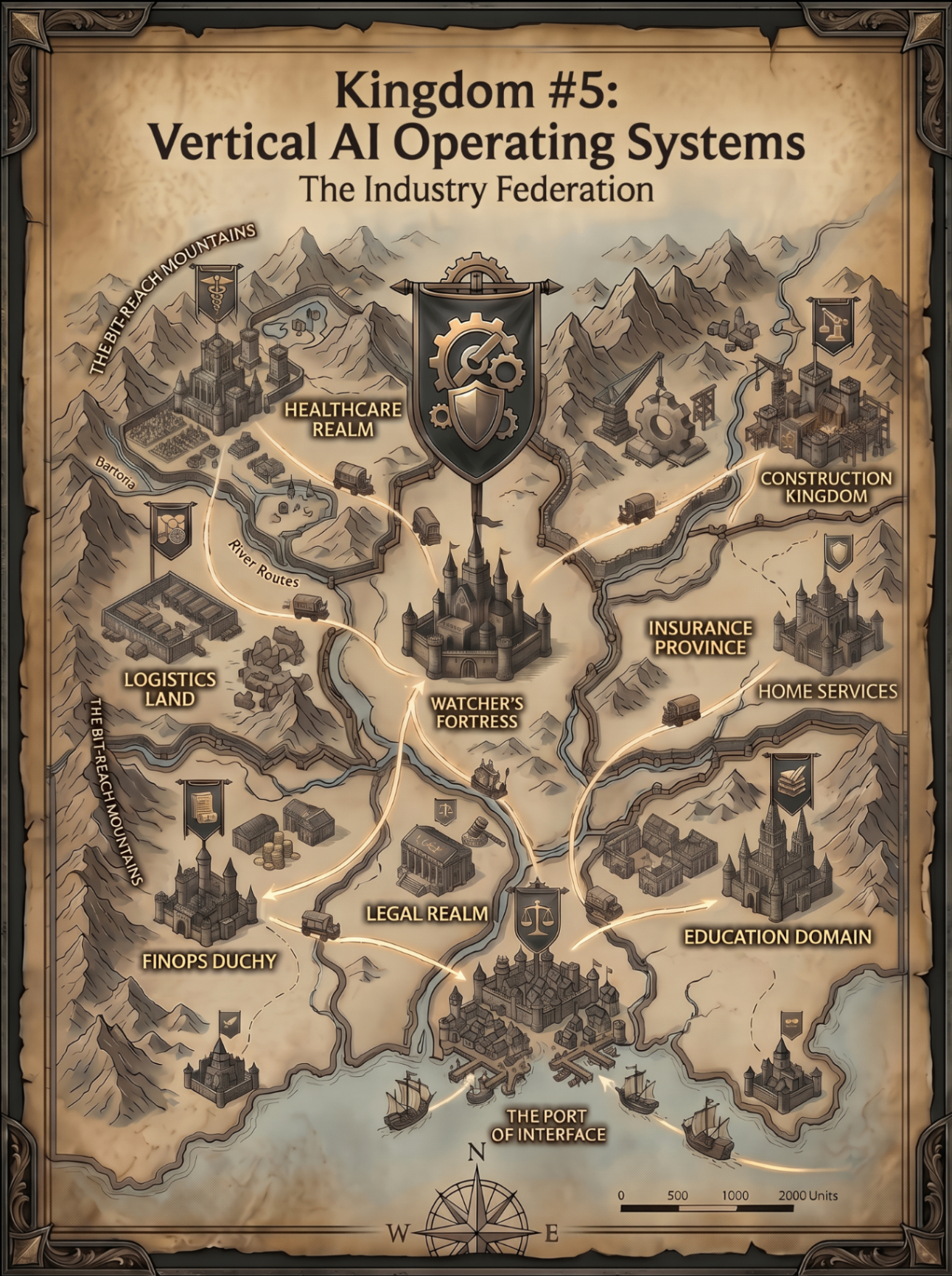
The takeaway is this: a few horizontal AI OS companies sit at the top and become some of the most valuable companies in history. Everything else either goes headless underneath them, or wins by owning a vertical the giants will not go down into.
Odyssey is a Kingdom V company. That is not an accident. That is the entire bet.
✦
Part I.5
A Quick Primer — What Is a System of Record, and What Is an Industry GPT?
Two terms carry the entire Odyssey thesis. If you don't understand them precisely, none of the rest works. So let's slow down.
The System of Record (SoR)
A System of Record is the software an entire vertical actually runs on. It is where every workflow happens and every workflow gets recorded — the transactions, the customer files, the invoices, the appointments, the compliance filings, the audit trails, the state changes, the exceptions. It is not a database sitting on the side. It is the operating surface of the business. Rip it out and the company cannot function tomorrow morning.
For a pawn shop, the SoR runs and records every loan, every ticket, every ATF filing, every buyback for the last fifteen years. For a construction firm, it runs and records every project, every RFI, every submittal, every subcontractor payment. For a law firm, it runs and records every matter, every billable hour, every trust-account transaction.
The SoR is boring. It is deeply embedded. It is painful to replace. And that is exactly why it is valuable.
As the Prologue laid out: building an SoR is the Battle of Troy. It takes a decade or more, and only a handful of warriors ever finish it. Which is exactly why the ones who do are the assets Odyssey is built to acquire.
Every dominant vertical software company of the last two decades was, at its core, a System of Record:
| Company | Vertical | Founded | Years to $100M ARR |
|---|---|---|---|
| Veeva | Pharma / life sciences | 2007 | ~6 years |
| Procore | Construction | 2002 | ~16 years |
| ServiceTitan | Home services (HVAC, plumbing) | 2012 | ~6 years |
| Toast | Restaurants | 2011 | ~6–7 years |
| Clio | Legal | 2008 | ~14 years |
These are the "old guard." They spent a decade or more grinding to become the source of truth for their industry. Once they got there, they were nearly impossible to dislodge. That is what an SoR earns you: durability.
The SoR is where the industry actually runs. Every workflow, every record, every audit trail. Whoever owns the operating surface owns the customer relationship for the next twenty years.
The old guard.
✦ $100M CROSSINGThe Industry GPT
An Industry GPT is a conversational AI product trained on a specific vertical's data, workflows, vocabulary, regulations, and edge cases. On the surface it looks like ChatGPT. Underneath, it is doing something a horizontal model structurally cannot: answering the questions an operator in that industry actually asks, with the context, citations, and compliance a horizontal model can't touch.
For an injury lawyer, the Industry GPT is trained on injury law and not the open internet. It cites the correct precedent, flags the jurisdictional exceptions, and delivers motions the lawyer actually trusts. For a doctor, it is trained on medical journals — again, not the open internet — and pulls the last 30 days of the patient's chart to map against current clinical guidelines.
The new guard — the companies rocketing from zero to $100M ARR in 18 months to 3 years — are all Industry GPTs:
| Company | Vertical | Milestone |
|---|---|---|
| Legora | Legal | $0 → $100M ARR in 18 months |
| Harvey | Legal | $100M ARR in 3 years, $350M by year 4 |
| OpenEvidence | Medicine | $50M → $150M ARR in 5 months |
| Abridge | Healthcare / clinical documentation | On the same curve |
| MagicSchool | K–12 education | $10M in first year of monetization |
The AI-native cohort.
✦ $100M CROSSINGWhy Industry GPTs Grow So Absurdly Fast
An Industry GPT is not a chatbot bolted onto the side of an SoR. That is what the incumbents ship. That is not what wins.
An Industry GPT is typically mobile-first. It is incredibly simple to sign up for — usually just an email address and thirty seconds. It is immediately valuable — the first question the operator asks gets a better answer than they've ever gotten from anyone, including their own senior colleagues. There is no training deck. No implementation manager. No six-week onboarding. No Gantt chart. You download it in the parking lot between appointments and by the end of the day you are recommending it to three peers.
We've all experienced this in our consumer lives with ChatGPT, Grok, and the rest. But a huge number of industries have not YET had their ChatGPT moment inside the business setting itself. When they do, one product wins — and it is almost always the one that felt native to the operator on day one.
Compare that to a traditional SoR sales motion — a six-figure ACV, a six-week sales cycle, a six-week implementation, and a Gantt chart on top. Both can end up at $100M ARR. Only one of them gets there in eighteen months.
That is the entire distribution story of the AI-native cohort. Harvey did not out-sell Clio. Harvey out-distributed Clio. OpenEvidence did not out-sell Doximity — it hit 300,000 doctors before Doximity's enterprise team could schedule the first meeting. The Industry GPT is a viral consumer download with an enterprise price tag stapled to the back end. That is why the curve looks the way it does.
Two clocks, one chart.
Two things jump out.
First: same verticals, different era. Clio spent 14 years building the legal SoR. Harvey and Legora built the legal Industry GPT in 3 years and 18 months respectively. It took them ~10x less time to hit the same milestone.
Second: the growth curve isn't just faster. It's structurally different. SoR companies grow at the pace of implementation cycles and enterprise procurement. Industry GPT companies grow at the pace of a viral consumer product with an enterprise price tag. That's why the graph in our Series A deck showing our ARR trajectory next to Harvey, OpenEvidence, Abridge, and MagicSchool — vs. the legacy trajectory of Veeva, Toast, ServiceTitan — matters.
Why Odyssey owns both
Every other player picks one army. The incumbents defend the SoR. The insurgents ship the Industry GPT. Both are exposed:
- The SoR-only incumbent gets attacked at the front end by the GPT insurgent and loses the customer relationship even while keeping the data.
- The GPT-only insurgent never gets the proprietary transaction data, so their model plateaus and they eventually get commoditized by the next horizontal release.
Odyssey owns both, deliberately.
The SoR gives us the memory. Fifteen years of proprietary, jurisdictionally-scoped, workflow-labeled data that no horizontal lab can synthesize.
The Industry GPT gives us the front door. The conversational interface every operator in the vertical opens first — customer of our SoR or not — becoming the top-of-funnel for the entire industry.
Together, they compound. The GPT gets smarter because it's trained on the SoR's exhaust. The SoR grows because the GPT funnels every operator in the vertical toward it. Neither the incumbent nor the insurgent can replicate that loop without a decade of catch-up.
The Fusion Thesis — The GPT Is the Remote for the SoR
This is the part most people miss on the first read. It is worth slowing down for, because it is the actual thesis of the company.
When you combine an Industry GPT with the SoR underneath it, something categorically new happens. The GPT stops being an assistant. It becomes the remote control for the SoR itself.
Think about what a traditional System of Record looks like to the operator using it: a thousand buttons on an exhausting screen. Twelve tabs. Six modules. Forty-seven dropdowns. Every one of them there because at some point over the last fifteen years a customer asked for it. The SoR is powerful precisely because it can do everything. It is also, for the same reason, exhausting to use.
Now put an Industry GPT on top. The operator does not click. They talk. "Pull up the last three tickets for this customer, run a lien search, draft the buyback contract with the standard terms, and text them a confirmation." The GPT parses that sentence and orchestrates the actions across the SoR — which is where the actual work executes and gets recorded. Real state changes. Real audit trail. Real compliance filings. Real payment rails. Real regulatory logging. The GPT is the interface. The SoR is where the work actually happens. The thousand buttons collapse into a conversation. The exhausting screen becomes a sentence.
That is the unlock.
The Industry GPT is the interface. The SoR is the engine. Either one alone is a great business. The two fused together is a monopoly.
The SoR-only incumbent gets attacked at the front end by the GPT insurgent and risks losing the customer's UI/UX layer entirely — even while keeping the data underneath.
The GPT-only insurgent is at risk of getting their data access shut off by the SoR whenever the incumbent decides to close it. Their capability plateaus if they can't reach five to ten years of the customer's historical data. And if a GPT-only insurgent is chasing a big, broad, name-brand vertical, they are also at risk of losing to a horizontal frontier lab — OpenAI, Anthropic — the day one of them decides to build an industry solution. More on that in Part III.
This is why we buy the SoR. This is why we build the GPT. This is why we fuse them. This is the entire game.
Every vertical we enter, we deploy this pattern. We buy the SoR. We build the Industry GPT ourselves. Then we wire them together so the GPT becomes the remote for the SoR the incumbent spent a decade building. Watch the operator adoption curve go vertical. Then repeat in the next vertical, with the same GPT engine — retrained on the new SoR's data — in weeks not years.
That is the Odyssey Doctrine, distilled into one move.
This is why the Odyssey stack is not "SoR plus AI features." It is a two-sided fortress built specifically for the vertical AI era. Old-guard defensibility. New-guard growth curve. That is the whole game.
✦
Part II
Who Is Winning and Who Is Losing in the New World Order
The Winners: The $100M Race Has Been Compressed by 10x
The best vertical software businesses of the last cycle were decade-long builds. (As the primer above illustrated, every old-guard leader — Veeva, Procore, ServiceTitan, Toast, Clio — was a System of Record that took 6 to 16 years to reach $100M ARR. The new guard is doing it as Industry GPTs in 18 months to 3 years.) Clio needed 18 years to reach $500M. Toast and ServiceTitan spent a decade grinding to $100M.
The best vertical AI businesses of this cycle are doing it in 3 to 5 years. Sometimes 18 months.
- Legora: $0 → $100M ARR in 18 months. In the same vertical as Harvey. Half the ramp.
- Harvey: $100M ARR in 3 years (Aug 2025). $350M ARR by summer 2026. On pace for $500M in under 5 years.
- OpenEvidence: $50M → $150M ARR in 5 months. Reached 300,000 doctors in ~1 year. Doximity needed a decade for the same audience.
- MagicSchool: $10M in its first year of monetization. 20% of American children now touch the product.
- GC AI: $1M → $10M in under 12 months.
Why is this happening? Three mechanisms:
- Distribution was pre-built. The last generation proved the wallets and workflows. The AI-native winners inherit a paved road.
- The budget is 10–100x bigger. Old vertical SaaS sold against the software-seat line. Vertical AI sells against the labor line. That's the "token uplift."
- Adoption friction collapsed. A conversational interface needs no training deck.
The median company, on two different clocks.
The Token Uplift: Why the Ceiling Moved
Old vertical SaaS lifted ARPA by embedding payments (a percentage of transaction volume). Vertical AI lifts ARPA by embedding AI credits against the labor budget, which is often 50–100x larger than the software line.
CDK Global
Toma AI
CDK Global
The dealer management system that runs the back office of roughly half the franchise dealers in North America.
Toma AI
AI voice agents that answer the phones at dealerships, book service appointments, and convert leads 24/7.
AI-native vertical software sells software access PLUS completed work. That single change raises the revenue ceiling by an order of magnitude — not because the market got bigger, but because ARPA can now expand far beyond old SaaS limits.
The MagicSchool Lesson: Domain Depth Is the Unfair Advantage
Adeel Khan, a former principal with no prior software background, built MagicSchool. Three years in, millions of teachers and ~20% of American children use it. His GTM team is 85–90% former educators by design.
Four takeaways from his playbook that apply to every Odyssey vertical:
- Recruit domain depth onto the cap table. If you haven't done the user's job, hire someone who has and give them real equity.
- Package every piece of context the horizontal model doesn't have. Roster, rubric, last week's data, the workflow your user actually runs. The wrapper isn't the liability — the wrapper is the durable margin.
- Use free as a temporary strategy with an end date.
- Price the entry impossible to refuse — and the renewal impossible to lowball.
This is exactly why every acquisition Odyssey makes is designed to keep the selling founder and their industry-expert team in the seats they held before the deal closed. Domain depth doesn't transfer through a data room. The pawn-shop veteran, the driving-school operator, the process-serving expert who spent a decade knowing every regulatory edge case in their vertical — those people are the reason the acquired SoR became the SoR in the first place. They are also the reason our Industry GPT will train on the right data, get answered questions from the right frame, and reach the right operators on day one. Odyssey pays for the SoR. Odyssey pays doubly to keep the people who built it.
The Wars Inside the Verticals
The software map has collapsed into three buckets: Horizontal AI Labs, Headless Utilities, and Vertical AI. The real fight isn't between the three. It's inside the vertical bucket.
Two armies are marching on the same territory — ownership of the Vertical AI Operating System:
- Army One: The Vertical System of Record. The incumbent with the data, the trust, the compliance. Risks: treating AI as a bolt-on feature.
- Army Two: The Vertical GPT / Agents. The insurgent with the front-end, but often without the record of transactions.
Odyssey's edge: we field both armies at once. We buy the SoR. We build the Industry GPT. Anyone playing only one loses to whoever plays both — and nobody else in these niches is playing both.
The Pricing Window That Funds the Whole Thing
There is a paradox at the heart of this moment: the exact same asset — a niche vertical SoR — is priced at post-SaaS multiples in the private markets while being the single most valuable input for the fastest-growing AI companies of this cycle.
Everyone who thought "we are a System of Record, we are safe" priced, sold, and shipped like it was still 2019. It is not 2019.
The founders in the vertical software community were still quoting "10x ARR" as if it were a law of physics. It is not a law. It was a market condition, and the condition changed.
Sit with three numbers.
Sit with the gap between the second and third numbers.
A vertical SaaS founder reads that AI companies raise at thirty times revenue, decides their company is worth eight, and then discovers that the actual buyers in their market are underwriting at one to three. That gap is not a pricing disagreement. It is a generational transfer of ownership waiting to happen.
"The old moat was being the System of Record. The new moat is becoming the system that helps the customer make money, save labor, and move faster."— Linear #176
These founders are not selling because their product is bad. They are selling because they are priced on what is left on the bone — and they have stopped adding meat. Flat ARR. Seat-based pricing. A services business they refuse to automate. A proprietary dataset they have never once monetized.
That is not a dying company. That is an underpriced asset.
Which is exactly why we are buyers.
The window is right now. Public SaaS multiples are at multi-year lows. AI-native multiples are at all-time highs. The exact same asset — a decade-old niche vertical SoR — sits on both sides of that gap depending on who owns it and what they do with it. We buy it at the low. We rebuild it into the high. That arbitrage is what funds every subsequent acquisition and, ultimately, the IPO.
No other buyer in the market is positioned to run this play at scale. Constellation buys for cash flow, not transformation. VCs won't touch legacy SoRs. PE will pay 3–5x but has no ability to ship an Industry GPT on top. That leaves Odyssey — with the sourcing engine, the operating model, the payments expertise, and the proprietary GPT stack — as the natural home for these assets during the single most attractive pricing window in vertical software history.
✦
Part III
The Odyssey Strategy (In Summary)
The strategy is not "buy vertical SaaS and layer AI on top." That's the pitch every hold-co is running. Here is the actual strategy.
1. Own the System of Record AND the Industry GPT
We buy the SoR. We build the Industry GPT.
The SoR is what we acquire — the boring, cash-flowing, decade-old operating surface every operator in the vertical already depends on. The Industry GPT is what we build — one engine, retrained per vertical on the SoR's proprietary data, deployed as the front door for every operator in the industry whether they use our SoR today or not.
This creates a two-sided defensive posture:
- The SoR insulates us from the Vertical GPT insurgents (they can't get our data).
- The Industry GPT insulates us from the SoR incumbents (we ship AI faster than any of them will).
We are simultaneously Army One and Army Two on the same battlefield. First to market with the combined stack has won every vertical so far.
2. Only deploy in verticals where the labs cannot compete
Reread Part III. If a vertical does not pass the filter, we do not enter it. No exceptions. This is the discipline that keeps Odyssey out of the kill zone.
3. Over time, strive to look more like a digital franchise than a software vendor
Over time, the goal is that in each vertical we serve, Odyssey looks less like a software vendor and more like a digital franchise. Software is the wedge, but the business around it — payments, hardware lock-in, supplies and physical goods, marketing, lead-gen, ordering, community, brand — is what creates a categorically different relationship with the operator. In a mature Odyssey vertical, an operator doesn't "use our software." They "run their business on us."
Software alone is not enough. From Linear #190:
"Business-in-a-box vertical software is what happens when a founder stops asking what workflow can I digitize and starts asking what does this operator actually need to run their entire business. The answer is almost never just software."
The box, exploded
A digital franchise: every scale advantage of a franchise, none of the royalties, none of the brand handover.
The Odyssey moat is:
- Software (wedge)
- Payments (attach)
- Hardware — POS, terminals, industry-specific rigs (lock-in)
- Supplies and physical goods (recurring, non-software revenue)
- Marketing, lead-gen, ordering (the operating surface)
- Community and brand (the villain we let them name — the corporate chain)
We are building a digital franchise. The operator keeps their name, their storefront, and their profits. Odyssey provides everything else. That is a categorically different business than "vertical SaaS."
✦
Part IV
Why the Labs Aren't Coming for Our Verticals
This is the single most important section for anyone underwriting Odyssey. If you don't believe this, don't join, don't invest, don't advise. If you believe it, you understand why the return profile is asymmetric.
The reflexive worry: "Won't OpenAI or Anthropic just build this?"
The answer is no. Not because they can't afford to. Because it doesn't fit their operating model, their cap table, or their kill list. Here's the structural argument.
1. Labs are fighting bigger battles at the horizontal layer
From the LLM Survival Map:
"LLMs are not coming for software as a category. They're coming for specific positions on a strategic map. There are 16 positions on this map. Only four are fortresses."
The labs are burning tens of billions of dollars fighting each other for the consumer and general-business AI OS. Every day they spend chasing a $2B pawn shop TAM or a $3B driving school TAM is a day they lose to Google, Meta, or Anthropic on the surface where the trillions actually live. They will not do it.
"It's more likely a Vertical AI takes out Procore than an LLM. The labs are fighting too many bigger battles to focus on anything too industry-specific."
The 4×4 survival map
2. When labs do go vertical, they chase the giant verticals — not ours
Anthropic and OpenAI have started hiring "vertical leads." Look at where they point them: healthcare, education, science, law, financial services. The verticals that are trillion-dollar addressable markets on paper, big enough for a lab to justify the org cost and the executive attention.
That is exactly the point.
A lab that just raised at a $500B valuation is not going to build a product for pawn shops, driving schools, bail bondsmen, coin-op laundromats, or independent pest control operators. The individual markets are too small to move the needle on their revenue plan, and the customer profile is too far from their org's center of gravity to run in-house. The math simply doesn't work for them.
The verticals Odyssey targets are structurally beneath the labs' attention threshold. That is a feature, not a bug. It is the exact reason the strategy works.
3. The moat is data the labs cannot synthesize
Frontier LLMs are extraordinary general brains, but they can't tell a boutique property in Lisbon why to raise a Thursday rate for a specific event window. OpenAI and Anthropic have the world's corpus of text — they do not have the corpus of what a hotelier actually did last Thursday at 6pm when a booking pattern shifted. That data, longitudinal and labeled by the workflow itself and jurisdictionally scoped, is not something a horizontal model can synthesize.
A dataset of human-labeled edits is something you can fine-tune into a model the labs can't replicate without your customer relationships. The model itself is rented from whoever is cheapest this quarter. Owned audience and authentic voice are the only moats the model companies can't ship.
Odyssey buys these datasets outright. That is what a niche System of Record is.
4. Our verticals are structurally inhospitable to the labs
Not every vertical is safe. We deliberately hunt in the ones that are. The filter:
- Low-to-no screen time — the operator is on their feet, not at a keyboard.
- Blue collar > white collar — the customer isn't reading tech Twitter.
- Low likelihood of DIY — the operator will never
pip installan agent. - Compliance / regulatory moats — ATF, FFL, state licensing, bonded requirements.
- Physical-world integration — POS hardware, supplies, hardware lock-in.
Pawn shops. Bail bonds. Shooting ranges. Driving schools. Coin-op laundromats. Martial arts studios. Wedding venues. Independent pest control. Self-storage. Car washes.
These are also the same markets that have been ignored by VC and often even by PE. Market size too small individually. Regulatory hair. Blue-collar founders who don't network in Menlo Park. But in aggregate — a multi-billion dollar rollup opportunity. Odyssey's Series A deck maps 25+ of these verticals against a $1T+ aggregate labor spend.
✦
Part V
How the Model Works
The Odyssey Operating Model, four moves per acquisition:
- BUYAcquire the System of Record at <3x ARR.
- OPTIMIZE PAYMENTSInterchange optimization + flip merchant-pay to customer-pay fees. Cash within weeks. This is what funds the build of the Industry GPT and the implementation of the Odyssey operating model on each new acquisition — it is why we stay cash-flow positive throughout the roll-up, not despite it.
- DEPLOY OUR INDUSTRY GPTRetrain Odyssey's proprietary Industry GPT engine on the newly-acquired SoR's data. Ship it as the front door for the entire vertical — customers of the acquired SoR and non-customers alike.
- MIGRATEMove every legacy customer onto the AI-native SoR. Expansion revenue via AI credits against the labor line.
The Math to $500M ARR
- Y1 (in progress): We acquired Coreware — our anchor asset — which took Odyssey from ~$6M ARR to ~$7M ARR in the first month post-close. From here the Year 1 sequence is: (a) grind Coreware from $7M ARR to $10M+ ARR through payments attach and Industry GPT deployment, (b) acquire a second SoR doing $4–5M ARR in a new vertical, (c) deploy our Industry GPT across the combined base to cross $15M ARR, (d) close a massive Series A — ideally $40M+ — to fund the next 4–6 vertical acquisitions.
- Y2: EBITDA positive. 4–6 additional SoR acquisitions in new verticals at <3x ARR. Every new SoR inherits the same proprietary Odyssey GPT engine — retrained on its data. Payments and AI credits attaching across the base.
- Y3: $100M+ ARR crossing. 4–5 verticals dominated end-to-end.
- Y5: $500M+ ARR. IPO-ready.
Once we hit the $15M ARR trigger, the Series A is $55M to go from $15M → $100M+ ARR, profitably. Every dollar buys revenue-printing assets, not runway.
✦
Part VI
Who We Hire
This is where most roll-ups die. They hire the same investment-banking associates and vertical SaaS operators they've hired for 20 years and wonder why the model doesn't produce different outputs.
Odyssey hires differently. We look for two qualities. Only two. Any more and everyone forgets what actually matters.
1. AI-Native.
Not "AI-curious." Not "willing to learn." AI-native. If you cannot describe how Claude, Cursor, GrokBot, Genspark, or whatever your stack is has changed your workflow in the last 90 days, you are not a candidate. AI is the operating system between you and every task you do — email, docs, research, analysis, coding, design, hiring, planning. All of it runs through AI by default. Doing things the old way is not acceptable. Not a soft preference. A hiring gate.
2. Relentless Hunger.
The window is now. The people who work here believe this has to work, and they act like it. Burn the boats. There is no fallback plan, no side project, no "let's see how this goes." If you need a stable, well-defined role at a company with playbooks and process guardrails and clear career ladders, this is not the place. We are building the vertical AI operating system for industries the rest of the world has ignored, and we are doing it against a clock that does not restart. The people who succeed at Odyssey are the ones who took that personally the moment they read it.
That is the entire filter. Two qualities. Every candidate, every role, every level.
The rest of this section is how those two qualities show up in the day-to-day of the company, and how we interview for them.
The Old World vs. The New World, Spelled Out
To make this concrete, here is what "AI-native" actually looks like in the day-to-day of a company. Every one of these contrasts is happening at Odyssey today. Every one of them is happening at the companies we compete with in the old column.
| The Old World | The New World |
|---|---|
| A customer files a bug. CS logs it. PM triages it. Engineering scopes it. It lands on a roadmap. Timeline gets estimated. Customer sees a fix in six weeks if they are lucky. | A forward-deployed engineer joins the call, replicates the issue live, ships a patch before the day ends. Customer thanks you before hanging up. |
| Marketing needs a real-time dashboard. Data team gets a ticket. Thirty days later there is a Looker board that already needs updates. | An operator prompts it into existence, connects it to the warehouse by end of day, iterates on it. Shipped the same week. |
| A customer asks for a custom report. CS says "we will pass it to product." It gets denied because it is not on the roadmap. | CS builds it themselves. Ships it in an afternoon. Sets up a weekly email to the customer to see what happened. Customer becomes a reference. |
| Onboarding is a six-week implementation project with a services PM and a Gantt chart. | An agent ingests the customer's legacy data, maps it to your schema, and stands up their instance overnight. CS shows up with their old data nearly ready to go in the system. |
| PMs write specs. Engineers estimate. Designers mock. Two-week sprint. Retro. Repeat. | The CS person or whoever the resident expert is prototypes the actual feature. Engineer reviews the prototype. Ships a scalable version in three days. |
| Content marketing hires an agency and pays $5,000 a month to write blogs. | An operator writes better content themselves in ninety minutes because they know the customer and the model does the drafting. |
The pitfall is real. Moving this fast breaks things. Bad prompts ship bad code. AI-generated dashboards can lie. Agents onboard customers into the wrong plan tier. Speed without judgment is worse than the old world.
But that is not the argument against AI-native operating. That is the argument for hiring people who have already broken things and learned. Not people who are still asking permission to try.
The scary part is how many candidates in the market still think the old cadence is normal. They quote two-week sprints as a feature. They say they "own the roadmap." They talk about cross-functional alignment meetings like it is a virtue. They have not picked their head out of the sand. Process and procedures are in place as guardrails. But they also slow really great people down.
If your interview process is not filtering for this, you are hiring like it is 2019.
How to Hire in the AI-Native Era
Stop asking about past accomplishments. Start asking what they built last weekend.
Ask candidates to walk you through their personal AI stack. Not the tools their company gave them. The ones they use on their own time. If the answer is a shrug or a single ChatGPT tab, you have your signal.
Ask them to show you the last thing they made. A dashboard, a prototype, a workflow, a piece of research, a landing page, an internal tool. Real artifacts. If they cannot produce one, they are not building anything on their own.
Give them a live task in the interview. Thirty minutes. Tools of their choice. Watch how they work. Do they prompt in full sentences and pray? Or do they orchestrate multiple tools, verify outputs, iterate? The difference is enormous.
Test for experimentation velocity. Ask how many new tools they have tried in the last thirty days. Ask which ones they abandoned and why. Curiosity is not a personality trait anymore. It is a job requirement.
Screen for taste. Anyone can generate output now. Very few can tell what is good. Show them three drafts of something and ask which is best and why. If they cannot articulate the difference, they will flood your product with mediocre AI output.
Look for people who use AI as their operating system. Not as a tool they open occasionally. As the layer that sits between them and every task they do. Email, docs, research, analysis, coding, design, hiring, planning. All of it running through AI by default.
You need people in 2026 who are all about experimentation. They are not stuck in their ways. They are all for relearning how to work in this new age. That is what I am looking for. There are no playbooks right now. Marc Benioff's school of SaaS looks like most other institutions of higher education. It does not translate to the real world — or at least the world of the vertical AI hypergrowers.
What Happens When the Whole Org Looks Like This
Every function moves at the speed of the fastest AI-native person you have ever worked with. Decisions that used to require three meetings happen in a Slack thread. Prototypes replace specs. Customer requests get answered the same day. Roadmaps get shorter because the cycle time is shorter.
David Senra just interviewed Luca Ferrari from Bending Spoons. Ferrari does not use job titles anymore. He runs one of the most efficient software companies in the world — roughly a 50% EBITDA margin on billions in revenue — and he has decided that traditional roles are a legacy artifact.
I think he is directionally right. The future org chart might just be four things: GTM, Product & Engineering, CS, G&A. That is it. A small number of extremely hardcore A players who build inside those four functions. No middle-management layer. No coordination tax. No specialists for things that AI now does better than humans. Bending Spoons is running AOL and Evernote with roughly thirty people per product — even with millions of users.
You do not get there by retrofitting your current team. You get there by hiring differently starting now.
Every role at Odyssey — deal sourcing, diligence, integration, product, engineering, GTM — is built on the assumption that the operator is running 10x–100x the leverage of a human doing the same job at a competitor. That is how a small team runs 5+ verticals simultaneously without collapsing under the operational weight.
Domain depth is also non-negotiable, per the MagicSchool playbook. Every vertical we enter, we recruit a domain operator with real equity and real authority. Not an "advisor." An operator.
✦
Part VII
How We Operate — The Odyssey Operating System
Quality operators need one system to run inside each company. Otherwise you get twenty brilliant people rowing in twenty different directions, which is what every rollup on earth looks like at year three.
Odyssey runs one operating system, in one vocabulary, on one cadence, across every portfolio company we own. Coreware runs it today. The next acquisition runs it on day one. The tenth runs it identically to the first. This is what makes the model actually compound instead of accumulate.
This section is short on purpose. If a sentence here doesn't change how someone works on Monday morning, cut it. The point is not poetry. The point is that a payments lead in Coreware, a customer-success manager in our next acquisition, and a CEO in our third can all open the same one-pager and know exactly which destination they are sailing toward, which pillars they own, and what their quarterly Quests are.
The Three Operating Principles
Everything downstream flows from three rules.
- One company, one plan. Strategy is the same thing across every portfolio company: a North Star, an Acropolis, exactly four Pillars, and the Quests beneath them. We never run two parallel planning systems.
- The Atlas is the master map. Every portfolio company keeps a single living document — the Atlas — that names the North Star, the Acropolis numbers, exactly four Pillars, the Quests behind each Pillar, the Quest owners, and the status of every Quest against the Atlas's own color code: Not Started, On Track, At Risk, Missed, Completed. If a campaign isn't in the Atlas, it isn't a Quest.
- Quests are quantified. A Quest without a number isn't a Quest — it's a wish. If a voyager can't defend the metric they've moved, by how much, by when, the work is not on the Atlas and carries no bonus weight.
The Operating Stack
Four layers. Each one flows mechanically into the next.
| Layer | Definition | Example |
|---|---|---|
| North Star | A single sentence describing the future role this company will play in its customers' lives. No numbers. Rarely changes. | “Coreware is the operating system every pawn shop in America runs their business on.” |
| Acropolis | The measurable 12–18 month destination. Three numbers carved in stone: Revenue (ARR), Retention (Net Dollar Retention), Profit (Free Cash Flow). | Coreware Acropolis: $15M ARR · 115% NDR · $3M FCF by end of Year 1. |
| Pillars | Exactly four strategic priorities that, if we win them, will mechanically produce the Acropolis numbers. Not more. Not fewer. Four. | 1. Ship the Coreware Industry GPT. 2. Flip merchant-pay to customer-pay on the payments book. 3. Migrate legacy customers to the AI-native SoR. 4. Land two lighthouse enterprise accounts. |
| Quests | The 90-day commitments each team and each voyager makes to advance a Pillar. Maximum four per person. Every Quest has an owner, a number, a due date, and a status. | “Ship the Coreware GPT beta to 250 pilot shops with ≥40% weekly active use by Sept 30. Owner: Head of Product. Status: OT.” |
How Alignment Works
Alignment at Odyssey is mechanical, not motivational.
- Every Quest rolls up. If a Quest can't be defended as "this advances Pillar X," it doesn't ship.
- Every Pillar rolls up. If a Pillar can't be defended as "this is what drives us toward tomorrow's Acropolis," it gets retired.
- The Acropolis rolls up to the North Star. If it can't be defended as "this is what fulfillment of the North Star looks like at this scale," we have a strategy problem — not an execution problem.
There is no version of good work at Odyssey that lives outside this cascade. If it does, it isn't work — it's decoration.
The Five Guardrails
There are five things we do not do. Ever.
- No disconnected goals. Every goal maps to a Pillar. Every Pillar maps to the Acropolis. Every Acropolis defends the North Star. No orphans.
- No overload. Four Pillars. Four Quests per voyager per quarter. If you can't fit it, you're not doing it — you're pretending to.
- No casual North Star changes. The North Star is meant to hold for years. Changing it means we were wrong about the company we bought, and that's a board-level conversation.
- No qualitative Quests. "Improve customer sentiment" is not a Quest. "Ship NPS from 42 to 60 by end of Q3" is a Quest.
- The Atlas is the only source of truth. No shadow trackers. No parallel scorecards. No PowerPoint decks that disagree with the Atlas. One map. One truth.
Compensation Is Wired to the Atlas
Every voyager's bonus is split into four equal 25% slots — three tied to the Acropolis numbers (Revenue, Retention, FCF) and one tied to that voyager's individual Quests. The math is brutal on purpose: miss one target inside a slot and the entire slot pays zero.
We do this because it forces individual effort and company discipline to land in the same quarter. You cannot be a hero on your own Quests while the company misses ARR — the compensation model punishes you for it. Conversely, the company cannot hit its numbers on the backs of ten people while forty coast — every voyager owns a piece of the Acropolis whether their function directly drives it or not.
Why This Matters for the Doctrine
Every rollup in history has failed at the same place: the second, third, and fourth acquisitions. Not the first. The first is an integration exercise. The second is a management challenge. The third is a systems failure waiting to happen. By the tenth, most rollups are running ten different companies pretending to be one, and the CEO is stuck being the human integration layer.
The Odyssey Operating System is the answer to that failure mode. Coreware runs it today. The next acquisition runs it on day one — before the wire hits, we are already writing the Atlas together with the incoming CEO. The tenth acquisition runs it identically. That is what turns a portfolio of assets into an actual operating company.
One vocabulary. One cadence. One Atlas per company. Every voyager knows where they sail, which pillar they own, and what number they will be measured on this quarter. That is not a nice-to-have. That is how compounding works.
For the full manual — including Chapter IV (The Atlas layout), Chapter V (Scorekeeping and Governance cadence), Chapter VII (the Coreware worked example), Chapter IX (how we review the business), and Chapter X (Odyssey involvement) — see The Odyssey Operating System v1.0, distributed to every portfolio company CEO, functional lead, and voyager on day one.
✦
Part VIII
Why We Beat Every Other SaaS Roll-up and Holdco
Constellation, Valsoft, Banyan, Tiny, Thrive — I've read every S-1, listened to every earnings call, and know their models cold. They are excellent businesses. We are not them.
Here is why our strategy wins in this era specifically:
1. Centralized > Decentralized
Constellation-style decentralization worked in a world where each vertical was its own island. In the AI era, the moat is a shared AI stack — one Industry GPT engine, one AI-native SoR framework, one payments rail — that gets deployed across verticals at 10x speed. Decentralized hold-cos rebuild the wheel every acquisition. We ship the same wheel 25 times.
2. Sourcing is our unfair advantage
Everyone else cold-emails brokers. We don't.
Luke spent a decade building the largest community in vertical SaaS: VerticalSaaSGroup.com — 100K+ followers, 2M+ views, the only podcast focused on vertical SaaS/AI, the largest conference in the space (Vertical Software Summit, Miami, Nov 4–5 2026, 400+ founders).
Deals come to us. Founders trust us. We cherry-pick — no auctions, no bidding wars, no brokers. That is why we can acquire at <3x ARR when the rest of the market is paying 5–8x.
3. The only true AI-native holdco doing this
Every other roll-up is an SaaS PE firm with an AI slide. We are an AI-native operating company with a rollup engine bolted on. The distinction shows up in every operational metric: time from close to first AI product ship, cost per acquisition integrated, ARPA lift per acquired customer.
4. We bring a proven stack, vertical to vertical
Coreware — our Year 1 anchor acquisition — is not just a cash-flow asset. It's the R&D lab where we built:
- The AI-native SoR framework
- Odyssey's proprietary Industry GPT — one engine, retrained per vertical on each acquired SoR's data
- The payments attach playbook
Every subsequent acquisition inherits this stack. Vertical N+1 ships in weeks, not years.
5. Payments focus and expertise
Every acquisition includes a payments flip. Interchange optimization. Merchant-pay → customer-pay conversion. This is not a bolt-on. It is a core competency, and it is why our unit economics on day-90 post-close look like nobody else's in the space.
✦
Part IX
Where We Are Going
Odyssey on the AI-native curve.
The Vision — The AI Company of the Niches
There are three AI companies that matter in the world we are entering. Every builder, every operator, every investor should be able to name them and the seat they hold.
OpenAI is the leading consumer AI company. It owns the general-purpose interface that hundreds of millions of people open when they want to think, decide, create, or plan. Kingdom I.
Anthropic is the leading general business AI company. It owns the horizontal workspace that global enterprises route their knowledge work through. Kingdom II.
Odyssey is the leading AI company of the specialty niches. Kingdom V — the industries the labs will never notice, the operators who will never open ChatGPT for their job, the workflows where a general model is worse than useless because it doesn't know the regulations, the vocabulary, or the physical constraints. That kingdom does not have a leader yet. It is going to have one. It is going to be us.
That is the seat Odyssey is built to hold.
We are not trying to be a bigger Constellation. Constellation is a decentralized cash-flow machine — a great business, but a fundamentally different game. We are not trying to be a better vertical SaaS company either. Vertical SaaS is what the incumbents already are, and the last decade proved it produces $500M outcomes over 15-year timelines. Neither ambition is big enough.
The ambition is the third seat. When a founder in a niche industry — a pest control operator, a driving school owner, a pawn shop, a bail bondsman, a martial arts studio — thinks about the AI product that runs their business, the answer should be Odyssey. When a regulator writes rules about AI in one of these industries, the party they call should be Odyssey. When the horizontal AI OS companies want to reach the operators inside these niches, the distribution partner they route through should be Odyssey. When a smart engineer at Anthropic or OpenAI decides they want to build for real people doing real work in the physical world — the natural next stop should be Odyssey.
One kingdom. One seat. Ours.
That is what we are actually building. Every acquisition, every Industry GPT deployment, every payments flip, every voyager we hire, every quarterly Quest is a step toward holding that seat before anyone else claims it. The IPO is not the goal — it is a milestone on the way to the seat. The seat is the goal.
Everything that follows in this section — the 12–18 month plan, the 5-year math, the trajectory chart, the empty-chair TAM — is in service of that vision. Read the numbers with the vision in mind. Nothing on this page is here for its own sake. Every dollar we raise, every SoR we acquire, every operator we recruit is calibrated against one question: does this get us closer to holding the third seat before someone else does?
If yes, we do it. If no, we don't.
Now → Series A Close
- Grind Coreware from ~$7M ARR to $10M+ ARR.
- Attach payments across Coreware's base.
- Deploy our Industry GPT on Coreware's vertical as the front door for the entire industry.
- Acquire another SoR.
- $15M ARR trigger for the Series A.
- Close the $55M Series A.
12–18 Months Post-Close
- Acquire 4–6 new SoRs in new verticals at <3x ARR.
- Deploy our Industry GPT as the front door of every newly-acquired vertical.
- Attach payments across the entire expanded base.
- Get to $100M+ ARR, EBITDA-positive.
DOZENS MORE UNTAPPED NICHES BEYOND THESE 25.
5 Years
- $500M+ ARR.
- 15–25 verticals owned end-to-end.
- IPO.
The Math, Broken Down
The math is straightforward and does not depend on hitting home runs on every deal. Every SoR we acquire follows the same trajectory: take it from ~$5M ARR to ~$15M ARR in 24 months through the Odyssey playbook (payments attach, Industry GPT deployment, migration to the AI-native SoR, land-and-expand into new operators in the vertical). After the 24-month ramp, we drive ~20% YoY organic growth per vertical in perpetuity — a very reasonable rate for a vertical AI OS with payments and AI credit expansion built in.
Stack that model across the acquisition cadence:
- Coreware (anchor) plus the second SoR we buy this year → combined ~$15M ARR by end of Y1.
- Series A funds 4–6 additional SoR acquisitions in new verticals across Y2. Each grinds from ~$5M to ~$15M ARR by end of Y3. Combined: ~$100M+ ARR crossing.
- Y5: additional acquisitions plus the 20% YoY compounding across the entire base. $500M+ ARR by end of Y5.
That is the path. No hockey stick out of thin air. No dependency on any single vertical breaking out. Compounding acquisitions × compounding organic growth × the token uplift on every acquired base.
That is the path to half a billion in ARR by Y5. It is not a hockey stick out of thin air. It is compounding on top of assets that already exist and already print revenue, with the two multipliers (payments + AI credits) layered on.
Compare that to the AI-native cohort: Legora, Harvey, OpenEvidence, MagicSchool. They are hitting these numbers from scratch. We are hitting them on top of a base. This is why Odyssey is on the AI-native curve — with the risk profile of a rollup.
✦
Closing
The Opportunity of a Lifetime
I've been building in and around vertical SaaS for a decade. I've watched founders build $100M ARR businesses over 15 years. I've watched AI-native founders do it in 18 months. I've watched labs chase the giant verticals and leave every niche wide open. I've watched the market simultaneously discount SoRs at all-time lows while re-rating AI-native vertical companies at all-time highs.
That gap is the opportunity of my lifetime. I believe it is the opportunity of yours too.
If you have read this far, you know what game we are playing. You know why the labs won't come. You know why our sourcing is a moat. You know why our stack compounds. You know why the math works.
IPO is the goal. Not a lifestyle business. Not a mid-cap. A defining company of the vertical AI era.
If that's what you want to build — welcome to Odyssey.
If it's not — thank you for reading, and Godspeed.
✦
Appendix
The Reading List
Every Odyssey team member is expected to have consumed the following. This is the curriculum.
Where the world is going
- The Seven AI Kingdoms — sevenaikingdoms.lovable.app
Who is winning
- Linear #193 — The $100M Race: How Vertical AI Compressed the Timeline
- Linear #183 — The Token Uplift: Why Vertical AI Sells Against Labor, Not Software
- Linear #182.5 — How a Principal Is Winning (the MagicSchool story)
Who is losing
What is happening in the new world
- Linear #194 — The Software Map Is Collapsing
- Linear #182 — The LLM Survival Map
- Linear #190 — The Branding Move Nobody Is Making (Digital Franchises)
Why the labs aren't coming
- Linear #182 — The LLM Survival Map (fortress positions)
- Linear #185.5 — Sell the Fish, Not the Pole (w/ Jake Saper, Emergence)
- Linear #184.5 — The Data Is the Treasure (Adam Harris, CloudBeds)
- Linear #183.5 — Owned Audience & Human-Labeled Data (Zain Jaffer)
- Linear #191 — The 1000 Question Rule & How To Build The ChatGPT of Your Industry
The Odyssey pitch deck
- Internal, current version dated September 2026.